
Co-Regulation in Children: How Kids Learn Emotional Self-Regulation
Feb 25, 2026
When a child is overwhelmed, such as crying, yelling, refusing, or shutting down, it is natural for adults to respond with explanation or correction. We try to reason with them, remind them of expectations, or move quickly to consequences. However, in moments of intense emotion, what a child is often lacking is not understanding of the rule or awareness of what they should do differently. What they are missing is regulation. When emotions surge, the brain’s higher-level thinking systems become less accessible. A dysregulated child quite literally does not have full access to the parts of the brain responsible for logic, impulse control, and flexible problem-solving. In that state, more information rarely helps.
Children do not learn regulation in isolation. Self-regulation develops gradually and is built through repeated experiences with regulated adults. This is where co-regulation becomes essential. Co-regulation is the process by which a calm, emotionally steady adult helps a child return to a more regulated state. It involves presence (being physically close), attunement (being aware and responsive to your child’s emotional states), and emotional steadiness (being able to remain calm and composed). Through tone of voice, facial expression, posture, and measured responses, the adult communicates safety to the child’s nervous system. As the child’s body begins to settle, their capacity to think, reflect, and respond appropriately begins to return.
Co-regulation is sometimes misunderstood as permissiveness or as rescuing children from discomfort. It is neither. It does not remove limits, ignore inappropriate behavior, or excuse harm. Think about it as a pause in a situation in which you put concerns for discipline to the side and address the emotional reactivity first. By focusing on regulation, it provides the biological and relational support necessary for a child’s nervous system to stabilize so that limits and learning can be effective. Expectations and consequences are most meaningful when a child is regulated enough to process them. In this way, co-regulation does not replace discipline; it makes discipline possible.
Decades of developmental research demonstrate that self-regulation develops first within relationships. Children learn regulation skills by watching trusted adults long before they can independently manage strong emotions. Through consistent experiences of being soothed, understood, and guided, children begin to internalize those regulatory patterns. Over time, what was once external support becomes internal capacity. Co-regulation, then, is not a temporary strategy but a foundational process through which children gradually build the skills required for emotional resilience, responsibility, and mature self-control.
What Is Co-Regulation? (From a Developmental Perspective)
From a developmental standpoint, co-regulation is the interactive process through which children gradually build the capacity for self-regulation within the context of supportive relationships. Self-regulation depends heavily on the prefrontal cortex, the area of the brain responsible for impulse control, emotional modulation, planning, and flexible thinking. This system is not fully developed in young children and continues maturing well into adolescence and early adulthood (full maturity is typically reached in the mid 20s). When we expect young children to consistently manage frustration, delay gratification, or calm themselves independently, we are often expecting skills that are still under construction neurologically. Think about it like this, kids are born with a small set of skills to get their needs met. This typically involves crying and moving their body to get our attention. Our kids will continue to use these skills, which progress into tantrums, until we teach them different skills to use instead.
Because of this developmental reality, children rely on external regulation before they can sustain internal regulation. Research consistently demonstrates that caregiver responsiveness, particularly warmth, attunement (noticing your child's emotional state and responding), and emotional availability, predicts stronger regulatory capacity over time (Morris et al., 2007; Eisenberg et al., 2005). When caregivers respond to distress in a predictable and supportive way, children’s stress-response systems become more organized and efficient. These repeated interactions quite literally shape neural pathways involved in emotional control.
Co-regulation is not a single technique but a pattern of interaction. This may be why it may seem confusing, as this may look different between different families. But there are some consistent underlying components, which includes a warm and responsive presence, emotional validation that communicates understanding rather than dismissal, calm modeling of regulated behavior, and gentle scaffolding of coping skills. Scaffolding means providing just enough support to help a child succeed without taking over the task entirely or doing it for them. Over time, as the child practices these skills within the safety of the relationship, less adult support is required. Just like with other skills, like teaching your child to dress themselves, you offer more support at the beginning and then gradually fade this away while your child’s skills increase.
In this way, co-regulation functions as the bridge between dysregulation and independent self-control. It is the mechanism through which children move from relying almost entirely on adult support to developing the internal tools necessary to manage emotions, behavior, and stress on their own.
Which Children Respond Most Easily to Co-Regulation?
Children Who Seek Closeness
Some children instinctively move toward connection when they are distressed. When upset, they may seek physical proximity, reach for a parent, accept a hug, or visibly soften in response to reassurance. Their bodies communicate what they need: closeness helps them settle. These children often show noticeable shifts in regulation when a caregiver offers calm presence, gentle touch, or steady verbal support.
From an attachment perspective, these children frequently demonstrate patterns associated with secure attachment. Attachment research has long described the caregiver as a “secure base” from which a child explores the world and to whom they return in moments of stress (Ainsworth et al., 1978). When children trust that comfort will be available and consistent, they are more likely to seek it, and that seeking behavior itself supports more efficient regulation. Longitudinal research suggests that children who experience responsive, emotionally available caregiving develop stronger regulatory capacities over time (Sroufe, 2005).
It is important to note that these children are not necessarily less emotional or less reactive. Rather, they are more likely to turn toward support in ways that make co-regulation straightforward. Because they allow the adult into the emotional moment, the adult’s calming cues, tone, posture, volume, can more directly influence the child’s nervous system. After repeated experiences of being soothed and understood, these children begin to internalize those regulatory patterns. What starts as external comfort gradually becomes internal self-soothing.
When Co-regulation has its Limitations
Children Who Withdraw or Escalate
Other children respond to distress in very different ways. Instead of moving toward connection, they may become aggressive, yell “leave me alone,” push a caregiver away, slam doors, or shut down entirely. Some appear outwardly defiant; others go quiet and inaccessible. In these moments, traditional forms of co-regulation, such as close physical proximity or increased verbal reassurance, may seem ineffective or may even intensify the reaction. Research on temperament shows that children high in negative emotionality or reactivity require more sensitive, tailored regulation support (Rothbart & Bates, 2006). We see far too often in our practices that this co-regulation message has been emphasized so much, parents feel they are abandoning their children if they do not stay present. This message only increases parental guilt and shame which makes the situation worse. If your child is becoming physically aggressive, you are allowed, and we strongly recommend, to physically distance yourself. For some kids (depending on age and development) that may just mean a few feet away, for others that may mean leaving the room for a few minutes. Co-regulation is NOT happening if your child spends that time hitting, kicking, and throwing things at you.
It is important to understand that these behaviors are not evidence that co-regulation does not work. More often, they are signs of a child who is deeply overwhelmed. When a child’s stress response is highly activated, their nervous system may default to fight (aggression), flight (avoidance), or freeze (shutdown). For some children, particularly those with more reactive temperaments or those who strongly value autonomy, close proximity during distress can feel overstimulating rather than soothing.
In these cases, effective co-regulation may look different. Instead of moving closer, a parent might lower their voice, reduce verbal input, and communicate calm availability from a slight distance. Statements such as “I’m here when you’re ready” or “I’ll give you space, and I’m nearby” allow the child to maintain a sense of control while still experiencing relational safety. The adult remains steady without chasing, cornering, or withdrawing in frustration.
It is also important to recognize something encouraging: the long-term goal of co-regulation is self-regulation. We want children to learn how to calm themselves. If a child is attempting to take space appropriately in order to settle, that can be a positive developmental step. The key distinction is whether the child is using space as a strategy to regulate or as a way to avoid repair or responsibility. When children begin to say, “I need a minute,” and can return once calmer, that reflects growing internal capacity.
For children who withdraw or escalate, the task is not to force closeness but to provide steady, respectful support that matches their regulatory style. Over time, repeated experiences of calm availability, paired with clear expectations once regulation returns, help these children build the same internal skills as those who readily seek comfort. The pathway may look different, but the destination is the same: a child who can recognize overwhelm, use appropriate strategies, and return to regulation independently.
Another note: your child may start to get upset again, after they were calm, when you try to readdress the situation. This is normal. We want to ensure we do get some form of resolution or repair, otherwise kids start to make the connection that when they have big behavior, parents remove the situations or experiences they did not like. Over time, this only limits your child's skills and they will continue to find it difficult. Imagine teaching your child a sport or music instrument, they need more practice to get better, not less!
Why Co-Regulation Reduces Aggression and Externalizing Behavior
When parents consistently practice co-regulation, the benefits extend far beyond calmer moments at home. A substantial body of research examining parental emotion coaching, responsiveness, and warmth shows meaningful reductions in aggression and other externalizing behaviors over time. Children whose caregivers acknowledge emotions, provide guidance through distress, and model calm problem-solving demonstrate lower rates of behavioral outbursts, improved executive functioning, and stronger peer relationships (Gottman et al., 1996; Eisenberg et al., 2005; Blair & Raver, 2015). These outcomes are not accidental; they reflect changes in how children learn to process and manage emotional arousal.
Aggression and externalizing behaviors are often behavioral expressions of dysregulation. When a child lacks the internal tools to manage frustration, disappointment, embarrassment, or anger, those feelings are more likely to spill outward. Co-regulation interrupts this cycle by helping the child’s nervous system settle before behavior escalates further. Studies in developmental psychobiology suggest that when children feel emotionally understood and supported, their physiological stress responses, including cortisol (the stress hormone) activation, decrease more efficiently. In contrast, chronic dysregulation and repeated experiences of emotional invalidation are associated with heightened reactivity and difficulty modulating behavior.
Executive functioning, which includes impulse control, flexible thinking, and planning, also develops in relational contexts. When adults guide children through emotional experiences rather than dismissing or overpowering them, children have more opportunities to practice pausing, reflecting, and choosing alternative responses. Over time, these repeated experiences strengthen neural pathways involved in self-control and social competence. As regulatory skills improve, peer relationships often improve as well, since children are better able to tolerate frustration, negotiate conflict, and recover from social setbacks.
Co-regulation does not eliminate expectations or accountability (If you want more information about validating without lowering expectations, check out this blog here). Instead, it creates the conditions in which expectations can be absorbed and behavior can genuinely change. Regulation makes reflection possible. When a child’s nervous system is calm, they are more capable of understanding impact, making repairs, and applying lessons the next time frustration arises. In this way, regulation precedes reasoning, and connection precedes correction.
How Parents Can Teach Regulation Through Co-Regulation
Parents often ask what co-regulation looks like in practice and how it translates into teaching children lasting self-regulation skills. While every child is different, there is a developmentally sound framework that can guide parents through emotional moments in a way that builds long-term capacity rather than short-term compliance.
Step 1: Regulate Yourself First
The foundation of co-regulation begins with the adult. Research on parent–child synchrony demonstrates that a parent’s physiological state strongly influences a child’s physiological state (Feldman, 2007). Children are highly attuned to subtle cues in tone of voice, facial expression, posture, and attitude. Even when words are calm, a tense jaw or sharp tone communicates stress.
Before responding to a dysregulated child, it is often necessary to pause briefly and settle your own nervous system. We know how hard this is and feel most parents would agree this is one of the most challenging parts of parenting. If you are very dysregulated, it is always okay to take a break yourself before responding to your child. While there are consistent messages you should respond immediately, it is better to take a break and respond while being calm and firm, rather than responding out of your own anger. Slowing your breathing, lowering your voice, relaxing your shoulders, getting on their eye level, and using fewer words can significantly shift the emotional tone of the interaction. In doing so, you are not ignoring the behavior; you are creating the conditions in which the behavior can actually change. In moments of distress, you are effectively lending your child your nervous system until they can access their own.
Step 2: Match the Child’s Regulation Style
Effective co-regulation requires attunement to the child’s individual pattern. For children who seek closeness when upset, gentle proximity, warm tone, and reflective statements about their feelings can help them settle more quickly. These children often calm through connection, and physical or emotional closeness feels organizing rather than overwhelming.
For children who are more autonomy-seeking or avoidant during distress, a different approach may be more effective. Sitting nearby without intruding, reducing verbal intensity, and calmly stating availability, such as “I’m here when you’re ready,” allows the child to maintain a sense of control while still experiencing relational safety. Avoiding chasing, cornering, or escalating verbal demands prevents additional stress. Matching the delivery to the child’s regulatory style respects their temperament while maintaining steady support.
Step 3: Validate Before Problem Solving
When children are emotionally flooded, validation helps lower the intensity of the experience. Research on emotion coaching suggests that labeling and acknowledging emotions supports integration between emotional and cognitive systems in the brain (Gottman et al., 1996). Validation does not mean agreeing with inappropriate behavior; it means recognizing the emotional reality underneath it. Both can be true at the same time: we can validate their emotions and disagree with their behavior.
Simple statements such as “I can see how frustrated you are” or “That was really disappointing” communicate understanding. In contrast, phrases like “Calm down” or “You’re overreacting” often increase emotional arousal. When children feel understood, their defensive response decreases, making them more receptive to guidance and problem solving.
Step 4: Practice Regulation Outside of Meltdowns
Regulation skills are best taught during calm moments rather than during crises. Just as we would not teach a child to swim during a storm, we should not expect new coping skills to emerge in the middle of intense distress. Practicing breathing techniques, role-playing coping strategies, expanding emotional vocabulary, and helping children identify physical “body clues” of dysregulation all build awareness and skill.
Repeated experiences of co-regulation during everyday stressors gradually become internalized. Over time, children begin to anticipate calming strategies, recognize early signs of escalation, and initiate coping skills independently. What was once externally guided becomes self-directed.
Step 5: Add Limits After Regulation Returns
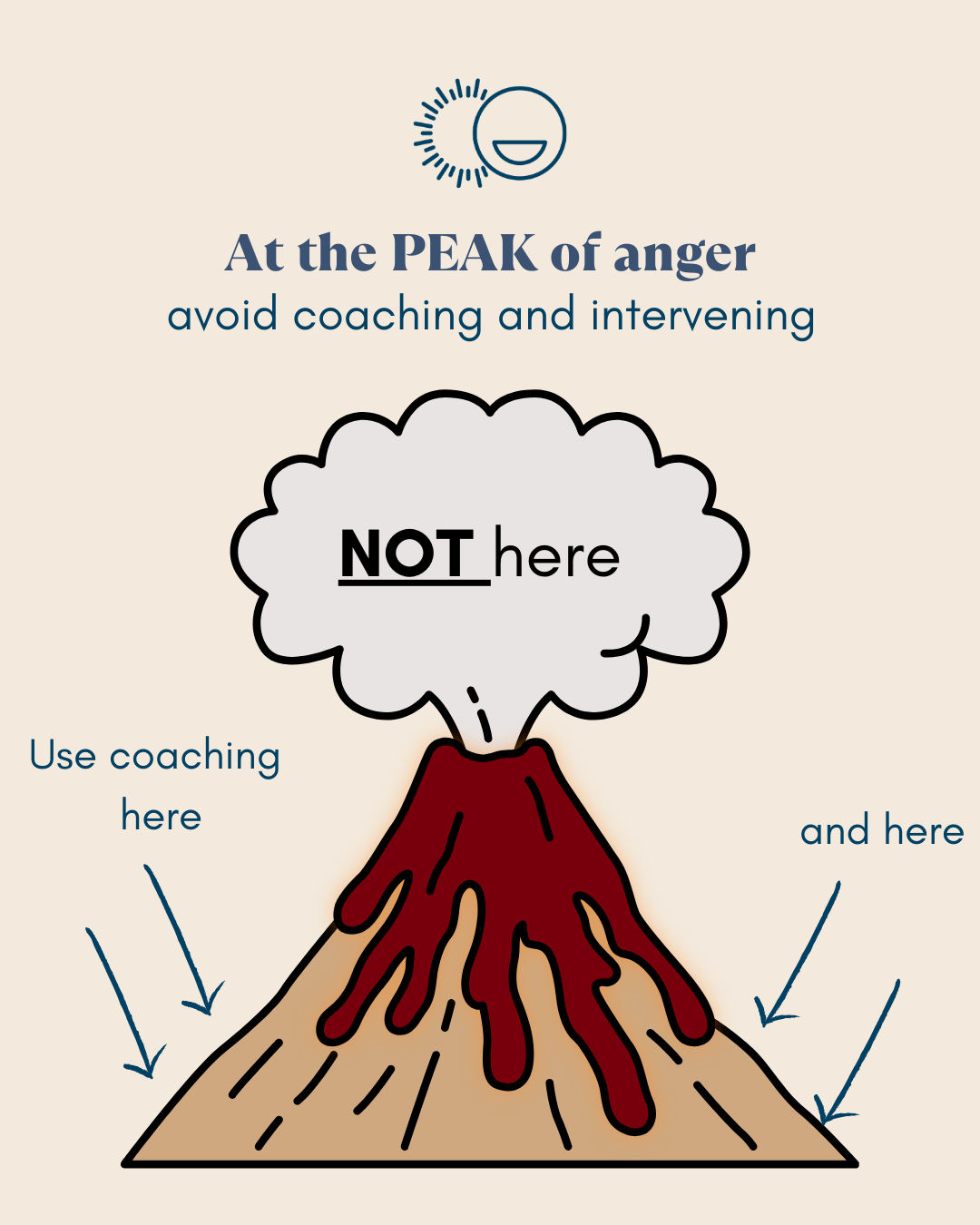
Co-regulation does not remove accountability; it makes accountability possible. Once a child has returned to a more regulated state, the thinking brain is accessible again. This is the appropriate time to review expectations, discuss what happened, repair harm if necessary, and practice alternative responses.
Addressing limits after regulation communicates two important messages: emotions are manageable, and behavior still matters. Children learn that big feelings are not dangerous and that responsibility follows recovery. Over time, this sequence, regulate first, then reflect and repair, strengthens both emotional resilience and behavioral maturity.
Here is an image which helps visualize this idea:
Final Thought
Co-regulation is not about eliminating big feelings or preventing children from ever experiencing frustration, disappointment, anger, or sadness. Big emotions are a normal and necessary part of development. They signal growth, unmet needs, social challenges, and increasing independence. The goal is not to quiet emotion but to teach children how to move through it in ways that are safe, constructive, and ultimately self-directed. This is what produces kids who can handle life.
In the early years, children rely on caregivers to help them interpret and manage overwhelming internal states. Over time, repeated experiences of being met with steadiness rather than fear, guidance rather than shame, and presence rather than withdrawal begin to shape how children respond to their own emotions. What starts as an external calming influence gradually becomes an internalized skill set. The child who once needed a parent’s voice to settle may eventually hear that same steady tone inside their own mind.
Children who instinctively seek closeness when upset can appear easier to regulate because their distress invites connection. Their pathway to calm is more visible. Children who withdraw, escalate, or push away often require more nuanced attunement. Their distress may be expressed through resistance or distance rather than proximity. Yet both groups share the same underlying need: a regulated adult who remains steady and emotionally available.
The foundation that supports long-term emotional health is not perfection in parenting, nor is it the absence of conflict. It is the consistent experience of calm, predictability, and connection. When parents respond to dysregulation with steadiness and structure, children learn that emotions are manageable and relationships are safe. Over time, these repeated relational experiences build neural pathways that support impulse control, flexible thinking, and resilience.
~Dr. Mortimer & Dr. Avirett
Scientific References
Ainsworth, M. D. S., Blehar, M. C., Waters, E., & Wall, S. (1978). Patterns of attachment.
Blair, C., & Raver, C. C. (2015). School readiness and self-regulation: A developmental psychobiological approach. Annual Review of Psychology, 66, 711–731.
Eisenberg, N., Spinrad, T. L., & Eggum, N. D. (2010). Emotion-related self-regulation and its relation to children’s maladjustment. Annual Review of Clinical Psychology, 6, 495–525.
Feldman, R. (2007). Parent–infant synchrony and the construction of shared timing. Developmental Psychology, 43(2), 329–340.
Gottman, J. M., Katz, L. F., & Hooven, C. (1996). Parental meta-emotion philosophy and emotional life of families. Journal of Family Psychology, 10, 243–268.
Main, M., & Solomon, J. (1990). Procedures for identifying disorganized attachment.
Morris, A. S., Silk, J. S., Steinberg, L., Myers, S. S., & Robinson, L. R. (2007). The role of the family context in emotion regulation development. Social Development, 16, 361–388.
Rothbart, M. K., & Bates, J. E. (2006). Temperament. In Handbook of Child Psychology.
Want more like this? Transform your home with our Parenting 101 Course, and weekly tips from two Child Psychologists.
Stay connected with news and updates!
Join our mailing list to receive the latest news and updates from Mind + Child.
Don't worry, your information will not be shared.
We hate SPAM. We will never sell your information, for any reason.
Mind + Child


