
Why Kids Need to Be Bored: How Boredom Builds Creativity, Independence, and Focus
Mar 12, 2026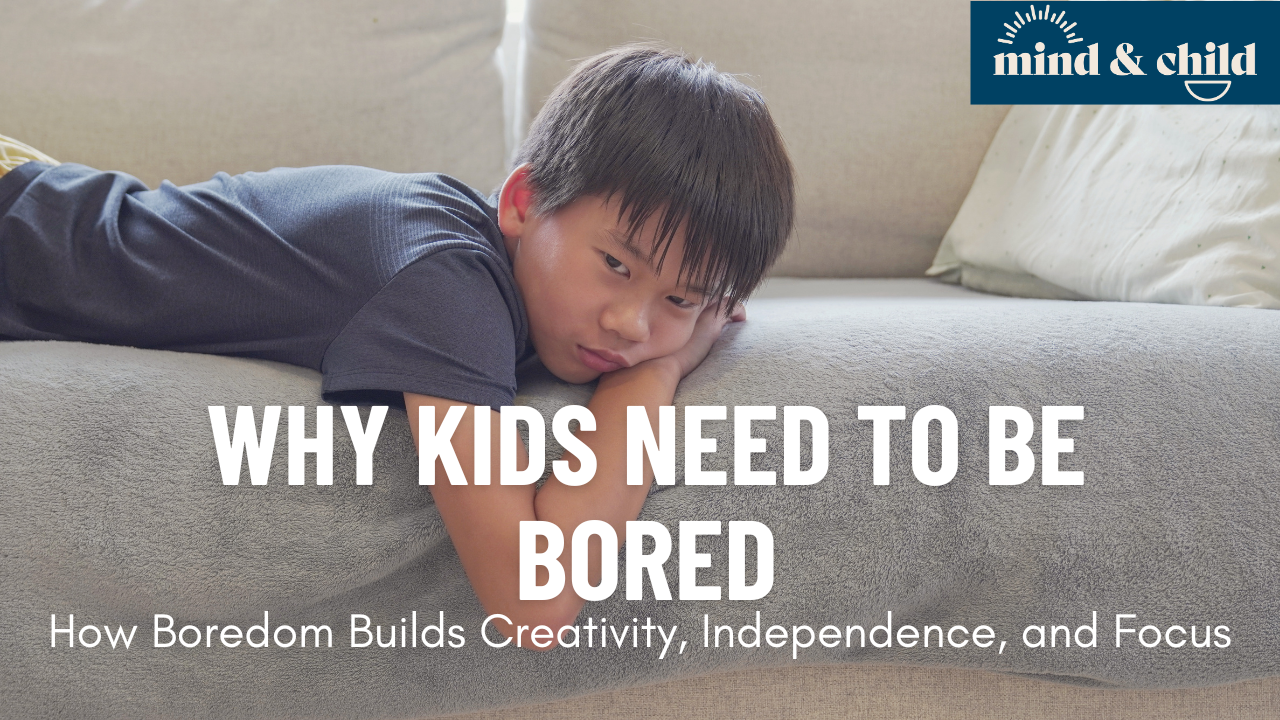
Why Your Child Needs to Be Bored
Many parents today feel a quiet pressure to keep their children constantly engaged. There are activities to plan, educational toys to rotate, crafts to prepare, and sports or lessons to schedule. When a child wanders into the room and says, “I’m bored,” it can feel like a signal that something has gone wrong — that we should be doing more.
But boredom is not a parenting failure.
In fact, boredom plays an important role in child development. Those stretches of unstructured time, when nothing particularly exciting is happening, are often where creativity, independence, and sustained attention begin to grow. For children, boredom is not simply an empty moment. It is often the starting point for figuring out what to do next.
The Modern Pressure to Entertain
Parenting expectations have shifted dramatically over the past several decades. Many parents remember long afternoons filled with unstructured play — building forts, riding bikes, wandering outside, or inventing games with neighborhood kids. I spent a lot of time making “mud pies,” making up songs while swinging on the swing set, or made up and wrote my own silly stories. Childhood today often looks very different. Activities are scheduled, environments are curated, and parents are frequently more involved in children’s day-to-day experiences.
This shift has brought many benefits. We understand far more about child development than previous generations did, and parents today are often deeply attentive to their children’s emotional needs. But one unintended side effect of this increased involvement is that parents can begin to feel responsible for filling every gap in their child’s day. We have also used screens as an automatic default or solution, making our kids more and more dependent on them.
When a child says they are bored, the instinct is to solve the problem. Parents might suggest an activity, offer a screen, organize a game, or start thinking about what could come next. Yet these moments of boredom are often exactly where children begin practicing important developmental skills.
Boredom Is the Beginning of Creativity
Boredom creates a pause between stimulation and self-direction. When children do not have an activity immediately provided for them, they begin asking a simple question: What could I do?
That question is often where imagination begins.
Children who have unstructured time frequently start inventing games, building with random materials, drawing, writing stories, or exploring their surroundings. They combine ideas, experiment with materials, and try things simply because they are curious about what might happen.
Research on creativity has long emphasized the importance of open-ended environments and self-directed exploration. Creativity researcher Teresa Amabile has found that intrinsic motivation, engaging in activities because they are interesting rather than assigned, plays a central role in creative thinking. Boredom often creates the space where that intrinsic motivation can emerge, allowing children to follow their curiosity instead of simply responding to external structure.
What Research Says About Unstructured Play
Developmental research consistently shows that children benefit from unstructured, self-directed play. When children are given opportunities to explore without rigid adult direction, they practice a wide range of cognitive and social skills.
Studies on play-based learning suggest that open-ended play supports creativity, flexible thinking, and problem-solving. Developmental psychologist Peter Gray has written extensively about how self-directed play allows children to experiment with ideas, negotiate with peers, and build confidence in their ability to generate solutions.
Similarly, pediatrician Kenneth Ginsburg has emphasized the role of free play in helping children build resilience and manage stress. Reports supported by the American Academy of Pediatrics describe unstructured play as an essential component of healthy cognitive, emotional, and social development.
Taken together, this research suggests that the goal is not constant stimulation, but balance — a combination of guided experiences and open time where children can explore their own interests.
Boredom Builds Independence
One of the central developmental tasks of childhood is learning how to initiate activities without constant adult direction. When adults consistently provide the next activity, children can become accustomed to relying on external stimulation. But when children occasionally need to figure out how to occupy themselves, they begin practicing independence.
They experiment with ideas, test possibilities, and discover what captures their interest. Over time, these experiences help children develop confidence in their ability to generate their own play.
This growing sense of initiative becomes an important foundation for later independence. Children who learn that they can create their own activities are better prepared to approach challenges in school, friendships, and problem-solving with a sense of capability.
Boredom and Attention Development
Unstructured play also supports the development of attention and persistence. When children choose their own activity, whether it is building with blocks, drawing, or inventing an elaborate imaginary game, they are often far more invested in the experience.
Because the idea originated with them, they are more likely to stay engaged and work through small challenges that arise during play. These moments provide natural opportunities for children to practice focusing their attention and sustaining effort over time.
Research on attention development suggests that deep engagement in self-chosen activities helps children build the skills needed for sustained concentration. In this way, boredom often acts as a transition point, allowing children to move from passive stimulation toward active engagement.
Boredom Gives Children Time With Their Own Thoughts
Another often overlooked benefit of boredom is that it gives children time to sit with their own thoughts. In a world filled with constant stimulation, screens, activities, background noise, and busy schedules, children have fewer opportunities to experience quiet moments where their minds can wander.
Those moments matter.
When children experience pauses without immediate distraction, they begin to practice internal skills that support emotional development. They reflect, imagine, process experiences, and experiment with ideas. These quiet mental spaces allow children to notice their thoughts and feelings and gradually learn how to regulate them.
Developing the ability to sit with boredom or mild discomfort is closely connected to self-regulation — the capacity to manage emotions, focus attention, and tolerate frustration. Children do not develop these skills by avoiding stillness or discomfort. Instead, they develop them through repeated experiences of navigating those internal states.
Boredom creates the opportunity for that process to begin.
The Parent’s Role in Boredom
None of this means parents should completely disengage from their children’s play. Parents still provide the foundation that allows children to explore. A supportive environment includes access to materials and toys, opportunities for outdoor play, and connection when children seek interaction.
But parents do not need to fill every moment with structured activities or constant entertainment.
Sometimes the most supportive thing a parent can do is simply allow the pause. When a child says, “I’m bored,” the response does not always need to involve immediate problem-solving. Instead, it can be a gentle invitation back to the child:
“I wonder what you might come up with.”
This small shift returns the opportunity for creativity and initiative to the child. If you really want to see this in action, save your recyclables and hand those to your child along with some scissors and tape. Or, save boxes - anything from an Amazon delivery to getting an appliance delivered - and let your child sit inside with a box of crayons or markers. We have seen our kids create "boats" and "spaceships," and then return to these over and over instead of expensive toys.
What Parents Can Say When Kids Say “I’m Bored”
Hearing “I’m bored” can easily trigger the instinct to offer suggestions or solutions. Yet sometimes the most helpful response is one that encourages children to begin thinking for themselves.
Parents might respond with curiosity:
“I wonder what you might come up with.”
“You have a lot of great ideas — what sounds interesting right now?”
“Sometimes boredom is where new ideas start.”
For younger children, it can also help to gently point them toward possibilities in their environment. A parent might remind them that their art supplies are on the table, that their blocks are in the living room, or that they could go explore outside.
The goal is not to ignore a child’s boredom, but to shift the responsibility for solving it back to the child. Over time, children begin to learn that boredom is not something someone else needs to fix. Instead, it becomes a signal that it might be time to explore their own ideas.
Letting Children Discover Their Own Ideas
It is easy to assume that good parenting means providing enriching experiences every moment of the day. But development often happens in the spaces between those experiences.
It happens during the quiet afternoon when nothing is scheduled. It happens when a child wanders around the house looking for something interesting to do. It happens in the pause when they begin imagining what they could build, create, or invent.
Boredom, in that sense, is not something parents need to eliminate.
Often, it is where creativity, independence, and focus begin.
Sometimes the most valuable thing we can offer children is not another activity — but the space to discover their own ideas.
~Dr. Jordana and Dr. Erin
Want more like this? Transform your home with our Parenting 101 Course, and weekly tips from two Child Psychologists.
Stay connected with news and updates!
Join our mailing list to receive the latest news and updates from Mind + Child.
Don't worry, your information will not be shared.
We hate SPAM. We will never sell your information, for any reason.
Mind + Child


